Mother of pearl meaning explained: what nacre is, how a shell builds it, the meaning of calm, purity and protection it carries, and how to wear and care…
Mother of pearl, also called nacre, is the smooth, iridescent layer that lines the inside of certain shells. Pearl oysters and freshwater mussels make it to protect their soft bodies, and they make pearls from exactly the same material. It is organic: not a mineral dug from the ground, but something a living animal builds, layer by layer.
Nacre is made of tiny flat platelets of aragonite, a form of calcium carbonate, stacked like bricks and held together by a thin organic protein called conchiolin. Each platelet is about as thin as a wavelength of visible light. When light passes through the stacked layers it is reflected and bent at every level, which creates the soft, moving rainbow sheen called orient, or iridescence.
Material: nacre, aragonite platelets bound by conchiolin. Origin: the inner shell of pearl oysters and freshwater mussels. Colour: creamy white, silver, pink and grey, with a rainbow sheen. Hardness: about 3.5 on the Mohs scale. Main sources: freshwater farms in China; pearl oysters from the South Seas, Australia, the Philippines and French Polynesia.
Born in the sea and built slowly, mother of pearl has long been linked with calm, purity and protection. In many coastal cultures it was carried as a charm for travellers on the water, and it is often associated with the moon and the tides. In modern crystal tradition it is worn as a reminder to stay gentle and steady. These are cultural beliefs rather than scientific properties: we share them because many people choose a material for what it represents.
A pearl and mother of pearl are the same substance in two forms. Mother of pearl lines the shell; a pearl forms when the animal coats an irritant inside its body with layer after layer of that same nacre. That is why both share the same glow, and where the name comes from: the shell lining was seen as the mother of the pearl.
Abalone shell, with its blue-green and violet flashes, is also a kind of nacre, from a different family of sea snails. Ours is the calmer, white-silver mother of pearl; abalone has its own page in our compendium.
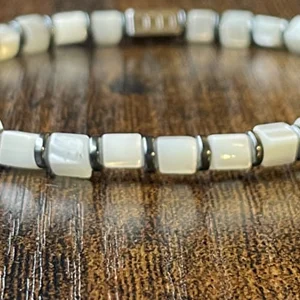
Its light is quiet, so it pairs well with dark stones. In our new bracelet, 4 mm cubes of mother of pearl alternate with thin hematite discs: white and graphite, soft and metallic. It is slim enough to wear next to a watch or stacked with other bracelets.
Mother of pearl is soft and organic, so treat it gently. Put it on after perfume, lotions and hairspray; take it off before swimming, showering and the gym; and wipe it with a soft dry cloth. Keep it apart from harder stones so its surface does not scratch.
Is mother of pearl a real gemstone? It is an organic gem, like pearl, amber and coral: made by a living organism rather than formed as a mineral. Is mother of pearl the same as pearl? It is the same material, nacre. Mother of pearl is the lining of the shell; a pearl is a separate bead of nacre. Can mother of pearl get wet? Occasional splashes are fine, but long contact with water, chlorine or soap can dull it over time. Is mother of pearl natural? Yes, ours is natural nacre cut from shell. Its colour and sheen vary from piece to piece.
{{ subtitle }}
{{ lead }}
{{ para.p }}